
Tagged: blog
Blog of the week – 26th April 2015
This weeks ‘blog of the week’ has another revision theme and goes to Head-teacher John Tomsett – This much I know about… what really works when preparing students for examinations.
In the post John shares his vast experience of preparing student for exams and enlightens us with some tried and tested strategies.
#neverstoplearning
Blog(s) of the week – 19th April 2015
Two blogs have caught my eye this week that tie nicely into exam revision.
1. Knowledge organisers – specify subject knowledge in meticulous detail – by Joe Kirby.
In this post Joe makes a case for being relentless specific with the subject knowledge that students need to know. This takes the form of one side of A4 – a knowledge organiser. This is not only useful for revision but also at the beginning of the teaching cycle of a new topic.
2. Sequencing lessons in the run up to exams – by Andy Tharby.
Andy’s post outlines his plan for revision in the run up to the exams with memory in mind. He also makes use of Joe’s knowledge organisers idea.
#neverstoplearning
#CPD – 15 minute forum: Positive relationships with staff and students
Sharon Porter | @sporteredu
15 minute forum: ‘Positive relationships with staff and students’ | Sharon Porter | @sporteredu
Date: 12/09/2014
Summary of forum.
Make it a habit.
- Make an effort at all times (even if you are feeling ‘crappy’).
- Smile and say “Hello!”, “Good morning!”, “Good day!” Even if you don’t know that member of staff or even if you don’t teach that student…it can make a difference to someone’s day.
Positive relationships with students.
- You will need to do the usual text book stuff
- Praise students
- Let them know that you are proud of them (verbally or written amongst feedback in books)
- Make sure that students are aware of your expectations; be firm, be fair be consistent.
Positive relationships with colleagues
- Make eye contact when you are talking (it might feel a bit strange to start with but it just comes across as rude if you don’t!)
- Listen. Really listen. Try not to sit there thinking about what you are going to say next…you’re not really listening. Summarise what you’ve heard and clarify this with ‘informed’ questioning.
- Express yourself; don’t just agree all the time. Challenge colleagues in conversation and occasionally ask “why?”
- Why do you think that? Where did you get that information?…..
- Give someone a compliment – I really liked what you had to say in that meeting because…; I thought that proforma you produced was really good; I particularly liked….
- Don’t shoot folks down if you don’t like what they have to say. Suggest alternatives
- Offer help – even if you are really busy, can you take on a small task to help a colleague? There is always someone in a worse position that you.
- Be positive…it will make you feel better!
#TMNSL 20/03/2014 – Workshop resources: Stop doing I.T. wrong!
Stop doing I.T. wrong! by David Morgan (@lessonhacker)

Stop doing I.T. wrong by David Morgan.
Workshop summary.
Digital learning is not something to be scared of or to be worried about.
It’s just learning.
No one called it ‘Pen based learning’ when we moved away from slate tablets, but I’m sure there were a few people reluctant to change their ways, or that didn’t quite ‘get’ the point of pens. In any case, digital learning is here to stay and should be a part of every lesson in some form, if only because it saves you time!

@lessonhacker
If you’re interested in finding out more then head to my blog [http://www.lessonhacker.com/] or read my book, which coincidentally has the same title as my workshop [http://www.stopgettingitwrong.com/] .
Buy David’s book – Stop doing I.T. wrong!
@LessonHacker on Twitter.
#neverstoplearning

#NeverStopLearning by @DavidJesus
‘Quick wins’ #16 – SLANT – Building habits in the classroom.
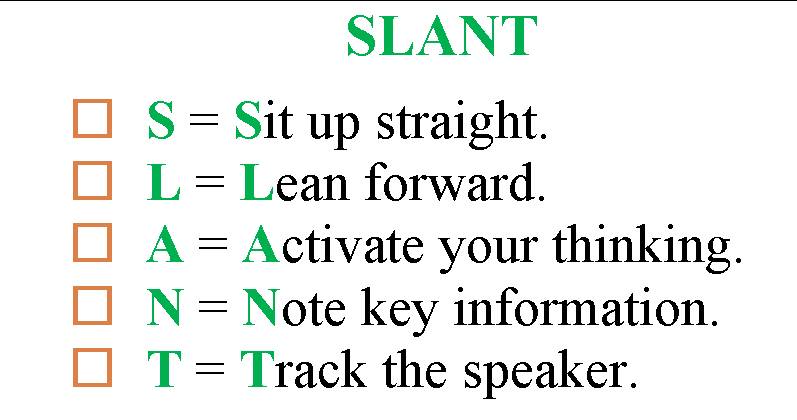
Image via http://olms1.cte.jhu.edu/29618
Why? I’ve struggled to get 100% attention from students 100% of the time. Quite often when I instruct students I’ll use the “3,2,12 technique to get students attention, which works well. But I then struggle to retain attention. This is made especially difficult when teaching in a Computing room – the lure of the computer screen can be too much for students. A typical instruction will have to be halted within seconds to address students who’s eyes have wondered back to their computer screen.
Possible solution. I needed a routine to retain student attention. I started my research by looking at Doug Lemov’s excellent collection of videos for his ‘Teach like a Champion’ book. I came across the video below.
It was during the video I saw a poster on the wall of one of the classrooms with the word ‘SLANT.’ Further investigation led me to discover the meaning of this term. SLANT is a strategy used to get students to pay attention not only when the teacher is talking but also when a student contributes to a discussion. An overview of the strategy can be found below…
Sit up: What is the right posture to sit in the classroom? Is it to rest your head on your hands, sit slouched in your seat or put your head down on the table? These are all positions that will put students to sleep. In order to develop attentive listeners, it is essential to encourage students to sit up straight with their back against the seat, feet placed firmly on the ground and hands on the table. This is the optimal position to ensure good learning and processing of information.
Lean forward: Another position that is critical to promote active listening is leaning forward. Students should be taught to lean forward during a lesson. It may also help teachers understand the interest level of the class and fine tune their presentation to make it more interesting for the students.
Ask and answer questions: This component can liven up the classroom and encourage students to be active in their learning process. Encourage them to clarify their doubts, answer questions, and discuss or debate on ideas. These question and answer sessions can help activate their thinking, encourage critical analysis of the content and strengthen their understanding of the lesson.
Nod your head: Nodding one’s head is a form of nonverbal communication to indicate that the lesson has been understood. When a teacher observes a student nodding his/her head, they may proceed with the lesson. On the other hand, failure to nod will signal that the student has not understood the lesson and the teacher may need to clarify or explain further. “N” can also stand for ‘noting down and naming key information’ which enables students to retain the information and makes learning stronger.
Track the speaker: The attention span of every student is different. Tracking the speaker is a visual cue to be attentive. Students should be encouraged to track both the teacher and other students who are presenting in class. The conscious effort to track the speaker will help students to be attentive at all times and prevent them from getting lost or daydreaming in class.
Taken from Professional Learning Board.
Resources.
SLANT poster for the classroom [PDF]

SLANT
Outcome. I am in the early stages of trialing this technique with Year 7, 8 & 9 students. I have found ‘Track the speaker’ particularly useful as a cue for students to pay attention to whoever is speaking. At the time of writing it has taken a lot of hard work to embed the routine but I am beginning to see more students listening to instructions and positively engaging in class discussions. Other teachers in my department have also started to embed these commands and the initial feedback from them is positive. One restriction at the moment is that students are only exposed to the routine in my classroom for 50 minutes a week so they don’t get to practice as often as I’d like. This means I have to continually remind them, but I believe the effort I put in is worth the outcome.
Post submitted by:
Stephen O’Callaghan
#neverstoplearning
Feedback. Please let us know how ‘SLANT – Building habits in the classroom’ worked for you. Leave a comment on this post or tweet us at @nslhub.
#TMNSL 20/03/2014 – Workshop resources: Differentiation
Differentiation by Chris Moyse (@ChrisMoyse)

Differentiation by Chris Moyse
Workshop Summary.
Our students differ from each other in so many ways:
· Prior knowledge and expertise
· Ability
· Language development
· Motivation
· Interest
· Family background and values
· How they learn best
· Where and when they learn best
· Speed at which they learn
· Levels of concentration
· Confidence and self esteem
· Physique
There are several ways by which we can make the learning more accessible for all our learners…
· Task
· Resource
· Outcome
· Questions
· Time
· Steps to take in an activity
· Support – peer/adult/virtual
· Grouping
· Pupil choice
· Curriculum
· Assessment & feedback
The top two sound too much like hard work for busy teachers so in this workshop we briefly looked at the possibilities of differentiating by choice.
Before though we considered the fact that John Hattie suggests that…
A teachers’ job is not to make work easy. It is to make it difficult.
He goes on to say that…
If you are not challenged, you do not make mistakes. If you do not make mistakes, feedback is useless.
Lev Vygotsky suggests that our students should operate within their ‘Zones of Proximal Development’. This involves facing challenges just beyond their current capabilities: a level of challenge that students can meet with help. Learning should feel tough, tricky, challenging, puzzling but not impossible.
To provide a challenging level of learning we need to know our students. Ensure that you have simple, understandable and usable pupil data available and use this data when planning and structuring teaching and learning in your classroom. Data together with any other relevant information about your students is best collated on an annotated seating plan or student profile. Have this annotated seating plan to hand and in the forefront of your mind as you prepare fabulous lessons. Remember to also have their recently marked books with you too as marking should always inform your lesson planning.
Start with the end in mind: plan for learning. Establish a clear objective and tangible outcomes avoiding the devil of low expectation – Must Should Could. Quite simply the wrong language to be using with teenagers!
Same task, different level of challenge. When you differentiate, you plan for the most able in terms of outcomes and then look at how to overcome the barriers for other groups in your class to enable them to access these outcomes – you then adapt resources, support and grouping to differentiate.
Research from Professor Robert Ornstein indicates that when learners feel as if they have some control and choice over the type of task that they are about to do, they feel positive and motivated.
So try to differentiate through choice eg Let the students choose their level of challenge or use workshops or drop in sessions: a series of inputs or demonstrations that students come to if, and only if, they need them
Differentiation top tips:
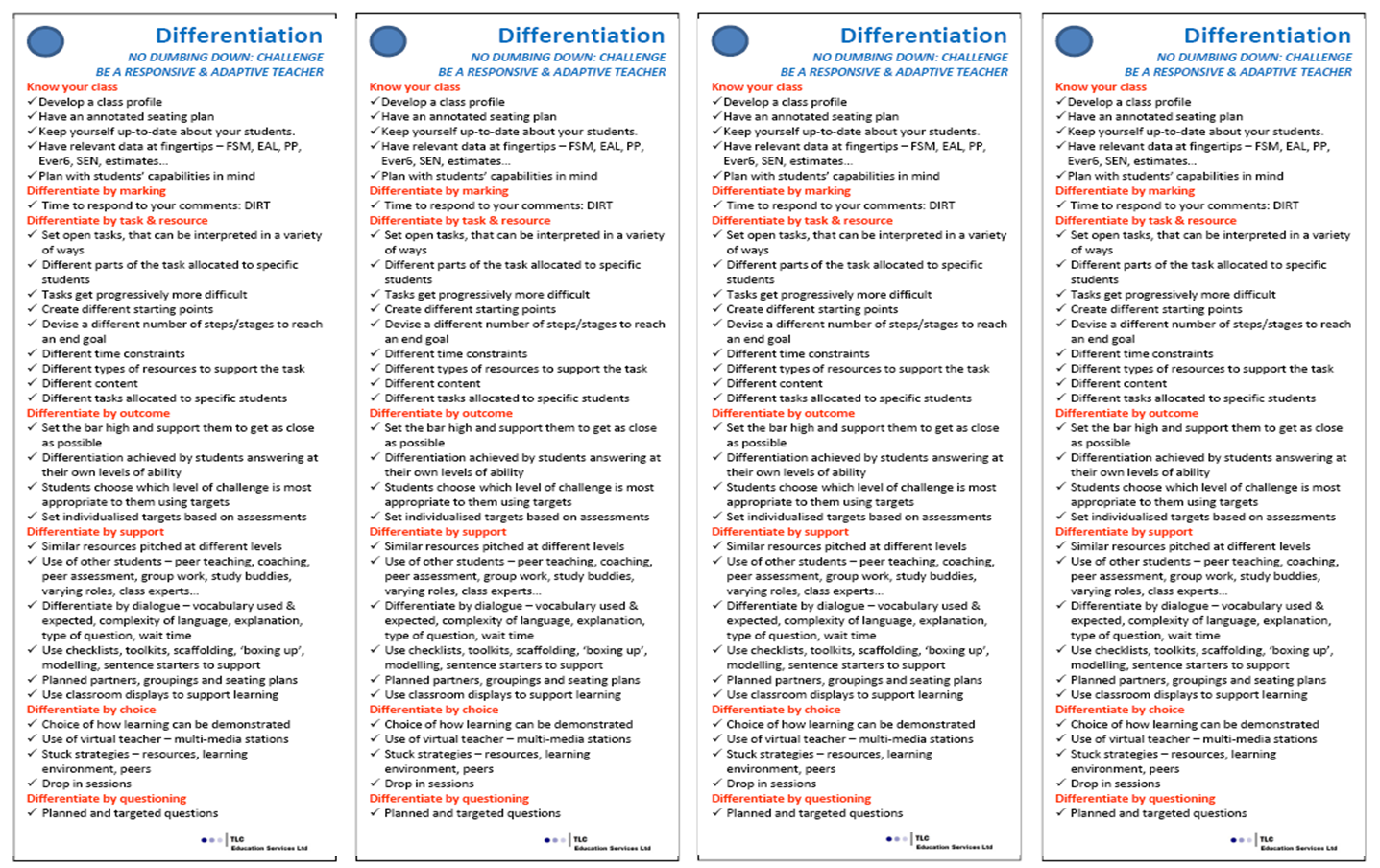
Differentiation bookmarks by Chris Moyse.
· Know your class and demonstrate this through annotated seating plans and student profiles. Use this ever-developing knowledge base to enable you to adapt your approach for who is in front of you.
· Challenge them. Have high expectations. Present learning without limits.
· Encourage your students to make and learn from mistakes. Then feedback can come into play.
· Opportunities for students to express their understanding and articulate their thoughts should be designed into any lesson. The more you hear and see the more you find out and the better you plan, respond and adapt to what happens during the lesson. Great teachers are great listeners too.
· Mark their books and provide your students with more work. Provide them with an opportunity to make your suggested improvements: the only time you will ever have 30 different lesson plans.
FREE RESOURCE: Differentiation bookmark.
@ChrisMoyse on Twitter.
#neverstoplearning
#NeverStopLearning by @DavidJesus
#TMNSL 20/03/2014 – Workshop resources: ‘Differentiated homework’
Differentiated homework by Sharon Porter (@sporteredu) & Tom Leahy (@MrTLeahy)

Differentiated homework by @sporteredu
Differentiated homework by @MrTLeahy
Workshop Summary.
The workshop on Differentiated Homework came about due to us considering the differentiated lesson. “We differentiate in lessons so we should differentiate homework…right?” Right!
How can we as teachers insist upon differentiating our classwork but then feel justified in giving the entire class the same piece of homework? It can become boring for the more able, consistently annoying for those who are finding the work challenging and it can be boring for the teacher too! To an outsider, it may seem strange that we are not differentiating homework, so what’s happening? Why are we all giving our students the same homework? Let’s consider the “Why? How? & What?” of this homework scenario
Why do you want students to complete homework?
o Practice? 10000 hrs makes perfect (Malcolm Gladwell)
o To cover more content? The flipped classroom (Bergmann & Sams)
How do you want them do it?
o Paper based or On-line?
o Weekly, Bi-Weekly?
What are the next steps?
o How can you maintain this level of homework?
o How much effort are you putting in when setting and marking the homework?
o How can you ensure that your students learn from the homework and not end up with lots of pretty displays? What level of feedback/marking is the most effective (#Takeawayhmk – how can you fairly assess the homework… S. Porter is currently researching this.)
Knowing the current approaches that are taken with homework and the completion rates, the following is a list of different homework that can be tried with classes – Differentiated Homework
- Two sided worksheet / laminated card
o Basic questions on one side and an extension of the concept or a problem solving task on the other side.
- On line homework (SAM Learning, MyMaths, ShowMyHomework, etc)
- Concept Cards – some staff made their own in the workshop

Concept cards.
- Choice Boards
Alternatives to Traditional HW
- Suggestions by the students of Kathleen Cushman “Fires in the Mind: What Kids Can Tell Us About Motivation and Mastery
- Takeaway HW (from “100 teaching ideas for Secondary Teachers” Ross Morrison McGill aka @TeacherToolkit)
@sporteredu & @MrTLeahy on Twitter.
#neverstoplearning
#NeverStopLearning by @DavidJesus
#TMNSL 20/03/2014 – Workshop resources: ‘Solo taxonomy’
Solo Taxonomy by Mat Pullen – @Mat6453
‘Solo Taxonomy’ by Mat Pullen.
Workshop Summary.
I have been thinking about SOLO taxonomy for a while and the impact it can have on student learning in PE. I have also looked at ways to make it easier for students to access.

Guide to Solo Taxonomy
I have previously blogged about Project Based Learning here and the feedback has been really positive. both staff and teachers are engaged in this approach to co construction of the curriculum and lots of teachers are telling me about their plans for embedding it in their schemes.
To move things on a bit I wanted to look at ways of supporting students to create their own learning models. To help facilitate the process of finding out what they need to improve on and where to find out how to do that.
That is where the link with SOLO comes in. I have used SOLO to great effect in practical sessions and students are really showing great progress in lessons and more importantly they kbow what they need to do to keep progressing.
In order to support this further I have created posters that I can use in sessions that allow the students to acces some visual cues to support them in their construction of lessons. The posters trigger augmented reality links to images and videos to help students check on technique and to assist in giving detailed feedback to each other.
The process is fairly simple, I created a poster on my iPad using Comic Life. Add this image to Layar.com in their creator section, add in video and images to the relevent sections and voila, augmented reality posters. The students can now access these with any device with the Layar app installed.
So now in a session, we start with students looking at a problem that they need to solve, they look at the skills they will need to develop to support them in overcoming the problem. Around the hall are posters with links to images and videos to help support their learning. They integrate numeracy to support their understanding of success, they use literacy to improve communication and feedback and they can see how they can progress using the SOLO stages.
This is a real change in lesson structure but really engages students to be active whilst learning a whole wealth of key transferable skills.
#neverstoplearning
#NeverStopLearning by @DavidJesus
‘Quick wins’ #4 – Deeper questioning

Why? Does anyone else find that every time they think of a brilliant, challenging, barnstorming question, their classroom suddenly resembles this image? No? Me neither. Too often I’ve found that after asking a question, I wasn’t placing a high enough demand on all of the class to consider it. I also noticed that, on occasion, I would ask questions which meant that most pupils did not need to do any thinking. For instance:
“Alex, why might Shakespeare have chosen to start ‘Macbeth’ with the three witches?” Potentially quite an interesting question, but by stating the name of the student first, it’s more difficult to guarantee that other students are also considering the question. Easily fixed:
“Why might Shakespeare have chosen to start ‘Macbeth’ with the three witches? (pause) Alex?” This seems better on the surface, asking the question, then giving wait time, then referring to Alex. But is there any real guarantee or that all students will be thinking?
Possible solution? In the video below, Dylan William describes the difference between ‘table tennis’ and ‘basketball’ style questioning, an analogy which I’m sure many teachers are familiar with. This ties in with the technique Pose, Pause, Pounce, Bounce which you can read about here.
However, if we want to use these techniques, we need to ensure that all students have fully thought about the question. In order to achieve this, I’ve been trying to make my initial question much more tenacious, demanding that everyone thinks about this question, and making sure that I’ve repeated the question at least twice. Now my question looks something like this:
“Right guys, I’m going to ask you a question and I need everyone to think about it. (pause to check listening) Why might Shakespeare have chosen to start ‘Macbeth’ with the three witches? Think really carefully about how this might affect the play. How would starting the play with the witches affect his audience? Think about it. Why might Shakespeare have chosen to start the ‘Macbeth’ with the three witches. (pause)”
After repeating the question, and giving plenty of wait time I’ll ask a student to offer an answer, before passing the question onward and building a discussion.
Variation. After the repeated question, give everyone a short amount of time to jot down their initial thoughts. Doug Lemov, in Teach Like a Champion calls this technique ‘Everybody Writes’. In his words:
“Effective teachers also set their students tp to hold rigorous discussions and reach rigorous conclusions by giving them the opportunity to reflect first in writing before discussing”
Resources.

Deeper Questioning grid (PDF) by @JOHNSAYERS
Reflective Deeper Questioning grid (PDF) @JOHNSAYERS
@JOHNSAYERS Blog post on questioning
This page from @MsFindlater collects together a range of very useful blog posts on questioning.
Often, I return back to this post from @HuntingEnglish, giving ten clear and easy to follow questioning strategies. This is also where I first saw the Dylan William video.
Outcome. Just as repeating instructions tends to lead to greater clarity before an extended task, repeating and rewording the question tends to lead to more thinking and more valuable discussion. With enthusiastic younger classes this means more excitable faces, more hands flying up into the air and more incredulous expressions as I demand on ‘no hands up’. With older classes, more meaningful discussion, more students willing to build on each other’s ideas, and less students idly letting just one of their peers do all the thinking.
Post submitted by:
#neverstoplearning
 Never Stop Learning