Here’s to the crazy ones… You are AMAZING. #TMNSL

If we want are students to amaze us we must first amaze them with our relentless, endless pursuit of learning. The role of a teacher offers the greatest opportunity in the world coupled with a complex set of responsibilities. The moment we stop reflecting on our practice, the moment we settle, is the moment we veer dangerously close to mediocrity.  It’s the commitment we make as teachers to never stop learning that will build good habits, develop great teachers and ultimately move the lives of the young people in our care forward.

Every teacher needs to improve, not because they are not good enough, but because they can be even better.

The above quote from Dylan Wiliam was one of the reasons that led me to start Never Stop Learning. I wanted to encourage colleagues to reflect on what they were doing and offer some help in doing that. So I founded this idea upon the following principles (via Jamie Smart):

postcard ver 1

Last night at the first annual Never Stop Learning teach-meet #TMNSL over 150 teachers from around the south-west (and beyond) volunteered for the opportunity to exercise and experience the above three principles to deepen their understanding. When remarkable people congregate in one place with a shared vision for improvement, something magical happens that is difficult to measure but very much experienced.

The people who think they are crazy enough to change the world are the ones who do.

The evening began with a truly inspirational keynote from Hywel Roberts. I’ve seen Hywel speak at a few events and he never fails to send his audience away with lots to think about and a renewed vigour for teaching great lessons. He speaks at a very personal level which is engaging, heartfelt and also very funny – a perfect way to start any teach-meet! Hywel is perfectly summed up in his website address – Create | Learn | Inspire – please pay it a visit.

@HYWEL_ROBERTS

@HYWEL_ROBERTS

The keynote was followed by a series of 10 workshops offering a wide selection of opportunities from leading whole school change to differentiation to using video for CPD. All workshops were planned and delivered by teachers committed to making a positive change, spreading their influence beyond just the school in which they teach. The typicality of comments coming from people who attended followed this theme…

nsl tweet


Click here to read tweets from #TMNSL

The crazy ones responsible for delivering expert workshops at #TMNSL were:

Chris Hildrew – @chrishildrew – ‘Great teachers.’

Amjad Ali – @ASTSupportAAli – ‘Creativity in the classroom.’

David Morgan – @lessonhacker – ‘Stop doing IT wrong.’

David Bunker – @mr_bunker_edu – ‘Teach like a champion.’

Dr Dan Nicholls – @BristolBrunel – ‘Leading change in schools.’

Chris Moyse – @chrismoyse – ‘Differentiation.’

Mat Pullen – @mat6453 – ‘Solo Taxonomy.’

Kate Heath & R Escourt – @artedu_kheath – ‘Practical ways to show progress over time.’

Sharon Porter & Tom Leahy – @sporteredu & @MrTLeahy – ‘Differentiated homework.’

Steve Gill & Jason Dayment – @mrgillenglish & @mrdaymentmaths – ‘Whole school oracy & numeracy.’

@chrishildrew delivering his workshop on 'Great teachers.'

@chrishildrew delivering his workshop on ‘Great teachers.’

The workshops were followed by further opportunities to connect with others and share discoveries through a series of micro presentations, opened up by the powerfully motivating Action Jackson – @ActionJackson (leader of the FixUpTeam). This was a remarkable second half to the evening with lots of teachers still going strong at 19:30 on a rainy Thursday evening in the middle of March. What followed was a series of short presentations that included lots of tips, ideas to think about and consider coupled with motivation and encouragement to continue to explore the role and practice of teaching.

The crazy ones responsible for presenting were:

@ActionJackson – You are AMAZING!

@edubaker – The behaviour triangle.

@hrogerson – Confidence grids.

@theheadsoffice – Improving writing through blogging.

@ASTSupportAAli – Teaching tips & tricks.

@sporteredu – The ace of… spades, clubs, diamonds or hearts.

@leading_in_pe – Plenaries – voting with your feet.

@mrgmorrison – Robert Blakes best bits & learning lunches.

@lessonhacker – Mid-term lesson planning.

@cgould6 – Working with newly arrived EAL students.

5 minute micro-presentations.

5 minute micro-presentations.

There was a great buzz and atmosphere throughout the evening which was down to the excellent calibre of speakers / presenters and the amazing audience who supported and engaged throughout. The evening was captured brilliantly through the artwork of David Jesus Virnolli.

The artwork of David Jesus Virnolli.

The artwork of David Jesus Virnolli.

#NeverStopLearning by @DavidJesus

#NeverStopLearning by @DavidJesus

Next steps…

Thoughts have already entered my mind for the next #TMNSL. Over the coming weeks I will endeavour to share, in more depth the ideas from the workshops in a series of shorter posts. Whether you attended #TMNSL or not I implore you to take time to reflect on your practice, re-visit your moral purpose regularly and make a pledge to never stop learning.

#NeverStopLearning

#NeverStopLearning

Thank you to our sponsors for the evening!

Crown House Publishing

Crown House Publishing

Western Computers

Western Computers


‘Quick wins’ #14 – Walking dictation – Team work, communication and accuracy.

@gapingvoid

Image from @gapingvoid – http://gapingvoid.com/

Why? Proof reading – self assessment. I am forever correcting the same mistakes which arise from a lack of proof reading. As soon as I question a student they know how to correct their work, but they don’t seem to do it!

Possible solution. Walking dictation. Students work in group of three – one student is the scribe and the other two are runners. Differentiated texts, images or sound files are placed across the classroom from where the groups are based.

One runner from each group at a time ‘walks’ to their allocated text, reads part of it and returns back to the group where they dictate to the scribe what they read. The other runner hears how far their team mate read and goes up to the text to read and then return to relay the next part of the text to the team. The scribe is using listening and writing skills and the runners are using listening, reading and speaking skills.

All members are working on their communication and team work skills.

What’s the carrot?  Well there has to be a success criteria and I use the least amount of points win. Winners win one point, second place two etc. However, points are incurred for misspelt words, or indeed missed words.

Resources.

Walking Dictation – How to – editable

Outcome. Challenge and drive for accuracy. It is an engaging task where students realise the importance of accuracy and to check over their work to eliminate avoidable errors.

Post submitted by:

Becky Thielen

Head of MFL

@EduThielen

#neverstoplearning

Feedback. Please let us know how ‘Walking dictation’ worked for you. Leave a comment on this post or tweet us at @nslhub.

‘Quick wins’ #13 – How to mail merge student test results into feedback sheets

Why? We wanted an efficient way to communicate the students strengths and weaknesses to students based on their most recent mock.  We saw the value in a question by question breakdown but it seemed time consuming.

Possible solution. We made a feedback sheet that had space for a question by question breakdown and comment on where to revise.  We then used a mail merge to drop individual results into the sheets.

Resources.

Outcome. The students said the detailed feedback really helped them focus their revision.  Allowing them to work on the topics they needed to instead of succumbing to the temptation to just practise what they were already good at.

Post submitted by:

Vyki Shaw

Head of Maths

@vykishaw

Blog

#neverstoplearning

Feedback. Please let us know how ‘mail merging student test results into feedback sheets’ worked for you. Leave a comment on this post or tweet us at @nslhub.

Hardwiring learning and effort = success

brain-train

I try to lead by challenging preconceived notions that people are born talented or lucky.  In Daniel Coyle’s The Talent Code: Greatness isn’t born it’s Grown he argues that talent is grown through purposeful practice…deep practice.  Below I give a specific example of how this can be seen in students’ learning.

“We all have the ability to profoundly change our levels of talent, our level of skill. Where clusters of great talent emerge there has been a culture created where individuals are constantly reaching and repeating, making mistakes, receiving feedback, building better brains, faster more fluent brains…inside the brain myelin acts like insulation on the pathways and connections in the brain – each time we reach and repeat we earn another layer – signal speeds in the brain start to increase from 2 mph to 200 mph – neuro broadband – (or the difference between normal and great).” (Dan Coyle)

What he is describing is the hardwiring of the brain – through repeated efforts, mistakes and improvement, until the action (or learning) becomes as natural as riding a bike. That is how talent is created.

This recently became really evident to me during a lesson observation of my Y12 Sociology class: one observer sat next to a student and asked her to deconstruct the exam question we were looking at (having heard me used the word ‘deconstruct’ in my instructions). I was amazed, and pleased, to hear her deconstruct the question effortlessly, without hesitation and to depth, drawing on prior knowledge, pulling out command words, key subject-specific words and implied meaning behind the question in a thorough analysis that was no less deep than if I had done it. I realised then that her success in that skill (which she hadn’t been able to do at the start of the year) came from the fact that this was how we started every topic that we studied: with an exam question that we deconstruct thoroughly. Essentially, us practising this skill at the start of every topic had resulted in it becoming ‘hardwired’ in her brain so that she could effortlessly pull it out no matter what the topic or question. Deconstructing an exam question is a transferable skill so I hope that she is able to make use of it in her other subjects as well.

time-effort-success

This message of repeating to hardwire your brain is exactly what I’m trying to get across to Y8 in my assemblies, preparing them for their mid-year exams, and reminding them that determined and deliberate effort = success.

Here’s another useful resource, Dan Coyle’s TED talk…

Post submitted by:

Domini Choudhury
Assistant Principal

#neverstoplearning

Feedback. Please let us know how ‘Hardwiring learning and effort = success’ worked for you. Leave a comment on this post or tweet us at @nslhub.

‘Quick wins’ #12 – Quick & simple student voice.

little effort

Why? The class is quiet. Students are getting on with work. But how do they feel about the lesson? Are they learning? Are they enjoying their learning? School is an extremely busy place the opportunity to reflect on this sometimes passes us by. I needed a quick way to answer these questions as it’s not always obvious to see. Paper surveys collected the information but were to time consuming to analyse. I needed something that required almost no prior planning and yielded immediate results.

Possible solution. A simple scatter graph. Label the axis however you see fit and invite small groups of students to plot their response.

Resources. This can be easily adapted to measure almost anything.

Quick feedback from students. Simple to set up and easy to analyse.

Quick feedback from students. Simple to set up and easy to analyse.

Outcome. I was able to gage student responses quickly and use that as a basis to ask more probing questions. Obviously this is just a snap shot, but valuable none the less in future planning and empowering students through student voice.

Post submitted by:

@Artedu_KHeath & @MrOCallaghanEDU

#neverstoplearning

Feedback. Please let us know how ‘Quick & simple student voice’ worked for you. Leave a comment on this post or tweet us at @nslhub.

‘Quick wins’ #11 – Tracking progress over time.

Multiple assessment sheets seemed like a good idea... Image by @gapingvoid

Multiple assessment sheets seemed like a good idea… Image by @gapingvoid

Why? In Art & Design we mark students coursework & exam projects numerous times before the final marks are submit at the end of the course. I found that students would occasionally lose the odd feedback sheet & sometimes even the assessment booklets I provided.

Possible solution. To make certain we have a clear record of progression in sketchbooks,  I adapted an assessment worksheet I saw at Redland Green Art Department for our GCSE & A-Level classes. It is just one A3 assessment sheet which clearly shows the progression students make over time in each of the assessment objectives. Every time work is marked, I do it in a different colour pen and pupils can see their work gaining more marks as they redraft & build up their projects.

 Resources.

GCSE Marking Progress Sheet (editable) – Easily adapted for any subject!

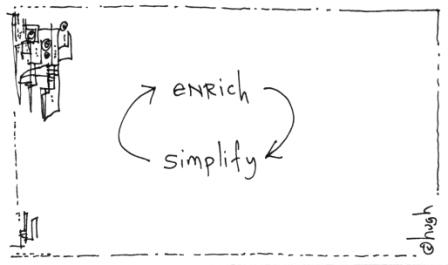
Shrinking the change - removing clutter and focusing on what's really important.

Shrinking the change – removing clutter and focusing on what’s really important.

Outcome. Pupils & teachers can see clearly see on one page (which is stuck into sketchbooks) where they are making progress and the areas in which they need to improve.

Kate Heath

Art Teacher / Artist / Leader

@ArtEdu_KHeath

#neverstoplearning

Feedback. Please let us know how ‘Tracking progress over time’ worked for you. Leave a comment on this post or tweet us at @nslhub.

Begin with the end in mind.

Begin with the end in mind.

Begin with the end in mind.

Recently I rediscovered a strategy that has revolutionised my teaching; a fundamental shift in mindset resulting in enormously simplifying my planning, consistently producing lessons graded as ‘Outstanding’ and receiving overwhelmingly positive feedback from student voice in my classes. It’s not new. It’s not difficult. It is simple.

The strategy (taken from Stephen Covey’s ‘7 Habits of highly effective people’): beginning with the end in mind.

I have now begun to structure the teaching of every topic/unit of work by starting with the end i.e. at KS4 and KS5, starting with sharing a possible exam question for that topic; or at KS3, starting with sharing the end of unit assessment, using these to create just one set of learning objectives for a sequence of lessons (differentiated by bands of marks in an exam question or success criteria for levelled skills and content in a KS3 assessment), rather than pandering to the misconception that every individual lesson requires a new and different learning objective.

We start by deconstructing the exam question (using the opportunity to draw out prior knowledge to help in deconstructing a question for a topic they haven’t studied yet and discussing a bullet-pointed checklist of the success criteria/mark scheme for the question) or, with KS3, drawing out the skills they will need to use and what the assessment task will be. Planning and delivery of knowledge and skills for the new topic becomes so much simpler as in ‘keeping the end in mind’ we regularly return to the exam question or end of unit assessment checklist to self or peer assess how much knowledge and skill we’ve gained to be successful in completing the question or assessment. My planning has simplified because I now know that simply with a well-thought out set of learning objectives shaped by the end goal, a passionate delivery of subject knowledge and content (drawing students into this with ‘storytelling’ and deep questioning that also encourages them to link their verbal answers to the end in mind), and encouraging students to regularly assess their progress against the end in mind, I have the tools to provide my students with at least a Good lesson each time.

I worried for a while that the students would be bored by starting every new topic in this same way and being so exams, or assessment, driven so I carried out some student voice work with my classes. The students love it. They say it keeps them focused, they understand how everything they learn fits in with what they will be assessed on (some students sharing horror stories with me of when they’ve had teaching where the end of unit assessment did not assess them on the skills they had been learning all term). Most importantly, the student voice revealed the sense of success the students feel as they work towards the end goal. Each time they are able to link a verbal answer to the end goal, or prove in a self or peer assessment that they have mastered the next skill or gained the next piece of knowledge towards that end goal, they feel a sense of success and can see the progress they are making.

Then, when they come to the end of the topic and properly complete the exam question or end of topic assessment, students are already in a good starting place because of the way the teaching of the topic has been structured. Finally, unless they gain full, or almost full marks in their exam question, my students know that they will never be allowed to just do the question once and that they will have to redraft it again. But that, and the magic of storytelling, whatever your subject, is for another time.

Here’s a video summary of Stephen Covey’s ‘7 Habits of highly effective people.’


Post submitted by:

Domini Choudhury

Assistant Principal

@DominiChoudhury

#neverstoplearning

‘Quick wins’ #10 – Formative feedback marginal gain.

Image by @gapingvoid - http://gapingvoid.com/

Image by @gapingvoid – http://gapingvoid.com/

Why? Returning formative feedback often has a demotivating impact, despite any positive comments. This is a particular issue for Key stage 4  C/D borderline students who find the leap to the next grade quite daunting, and able students attempting to bridge the gap between A-A*.

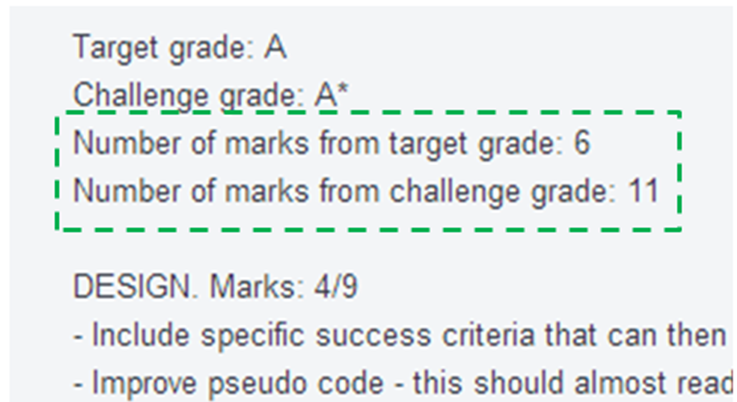
Possible solution. To direct student focus to improving I have added an extra comment to assessment sheets. When students receive their assessments they now see not only their target grade and current grade but the marks required to get to the next grade,

Resources.
Here are a couple examples of this marginal gain being implemented…

Example from a KS5 Art progress booklet.

Example from a KS5 Art progress booklet.

Example from a KS4 Computing class.

Example from a KS4 Computing class.

Outcome. The effect was immediate as students focused on the marks required to achieve the next grade rather than their current grade.A year 10  student commented on the fact that he was just 2 marks away from achieving a C grade, not that he had a D grade. In his previous assessment he had felt quite despondent. It is a simple yet, effective motivational tool that provides an instant snapshot of how close they are to the next step.

Post submitted by:

Rachel Taylor-Evans

Head of Art

#neverstoplearning

Feedback. Please let us know how ‘Formative feedback marginal gain’ worked for you. Leave a comment on this post or tweet us at @nslhub.

‘Quick wins’ #9 – Developing oracy: Getting students to respond in full sentences.

Why? Students, due to apathy or due to the state school pandemic of not wanting to sound clever, often avoid giving a thorough explanation to reveal the depth of their learning; rather, given the chance, they will utter a barely audible ‘yes’ or ‘no’ and quickly retreat back into their protective shells. Sound familiar?

Possible solution. To combat this – a simple solution: have high expectations of students’ oracy so that they respond in full sentences.

a) To achieve this, get students to rephrase your question as part of their answer.

For example: Why does Dickens open his novel, Bleak House, with pathetic fallacy?

Student answer: Dickens opens his novel, Bleak House, with pathetic fallacy because…

b) When posing an open-ended question, provide an oral scaffold to extend students’ thinking.

Resources.
An example slide scaffolding oracy.

Example oracy scaffold.

Example oracy scaffold.

Outcome. Having high expectations around students’ oracy has resulted in students providing in-depth feedback as opposed to giving one word answers. In English, levels can also be attached to the quality of student responses: level 5 is linked with being able to explain your ideas; level 6 requires students to explore ideas, thereby showing that information can be interpreted in different ways.  As a result, students have evolved to see the value and importance of talk in a lesson – no longer is it an opportunity to doze off or give a mere one word answer, which had previously given them the impression that they were making a meaningful contribution to the lesson – but, by giving extended answers, students now realise that this is an integral part to the lesson. It has also helped to bridge the gap between the talking and writing stage of the lesson. Students recognise that if they can articulate their ideas verbally, this also helps them to translate their ideas to the page.

Post submitted by:

Steve Gill

English Teacher

@MrGillEnglish

#neverstoplearning

Feedback. Please let us know how ‘Developing oracy: Getting students to respond in full sentences’ worked for you. Leave a comment on this post or tweet us at @nslhub.

Grow your leaders

Having taken on more line management duties this year I have been thinking about the quality of the line management meetings and how they serve to develop leaders. Our approach to leadership at Bristol Brunel strives for Leader – Leader relationships (David Marquet) and, as such, relies on the person being line managed to use language such as “I intend to …. Because…” rather than “ Can I do….”. A link to David Marquet’s TED talk “How Great Leaders Serve Others” is below:

The GROW model has been used successfully to improve colleagues teaching through coaching, our Assistant Principal Gemma Williams spent some time telling me about how the coaching model she used works. A summary is below:

Grow your leaders.

Grow your leaders.

I found this list of simple questions to be particularly useful during coaching sessions:

Goal

What do you want to achieve?

What is important to you right now?

What areas do you want to work on?

Describe your preferred future for this area.

What do you want to achieve as a result?

Reality

Where are you now in relation to your goal?

On a scale of 1 -10 where are you?

What progress have you made so far?

What is working well right now?

Options

What are your options?

How have you tacked this/ a similar situation before?

What could you do differently?

Who do you know who has encountered a similar situation?

Give me 5 options

If anything was possible what would you do?

What else?

Will

Which options work best for you?

What actions will you take?

When are you going to start?

Who will help you?

How will you know you have been successful?

It is early days yet in terms of me using this model in Line Management meetings, however, I believe strongly that this will provide my colleagues with a few key outcomes:

–          A clarity of thought process for both of us when discussing challenges, building capacity to solve problems and move to action.

–          Reducing my automatic response to try and solve problems for people.

–          Explore more rigorously together all possible options before moving to action.

–          A commitment to clear actions based on an analysis of the most appropriate solution.

–          Ownership of the change and improvement journey.

I look forward to seeing and feeling the impact of this approach to line management meetings.

Jon Jones

@jonericjones

Vice Principal

#neverstoplearning

Feedback. Please let us know if you found this post useful. Leave a comment on this post or tweet us at @nslhub.